
Two numbers decide most of what a steel roof will do for you. Gauge is thickness, and it runs backwards: a lower number means thicker metal. Twenty-nine gauge is common ag-panel and it is genuinely fine over a shed. Step up to twenty-six on any building a hailstone can find, and around Saint Clair that is all of them. Twenty-four is standing seam territory, thick enough to hold a flat plane across a long run. Profile is the rib shape: taller ribs spaced wider shed faster and carry load better on low slopes, shorter tighter ribs read smoother from the road. Ask for both numbers on any steel roof quote you get.
Steel roof conversations around Saint Clair usually start with a number that does not mean much on its own. Somebody has a price in hand and no idea whether they are looking at a panel that belongs on their house or one that belongs on a hay shed. The two things that actually separate one steel roof from another are how thick the metal is and what shape is stamped into it, and neither one is complicated once somebody explains it standing in your driveway. Here is what those numbers do, and where they matter on the buildings out here.
Gauge is thickness, and the number runs backwards
Gauge measures the thickness of the steel, and it is the one number people misread most, because lower means thicker. Twenty-nine gauge is the common ag-panel thickness. It is thin, it is inexpensive, and it is genuinely fine over a shed where the roof is doing a job and nothing more.
Twenty-six is a noticeable step up in stiffness, and it is what we lean toward on anything a hailstone might find. In St. Clair County that means essentially every building on the place. Twenty-four gauge is standing seam territory, thick enough that a panel holds a flat plane across a long run without waving in the light. That last part matters more than it sounds. A thin panel on a long uninterrupted slope catches sun and shows every ripple, and once you have noticed it you will notice it every time you pull in.
Rib profile changes both drainage and how the house looks
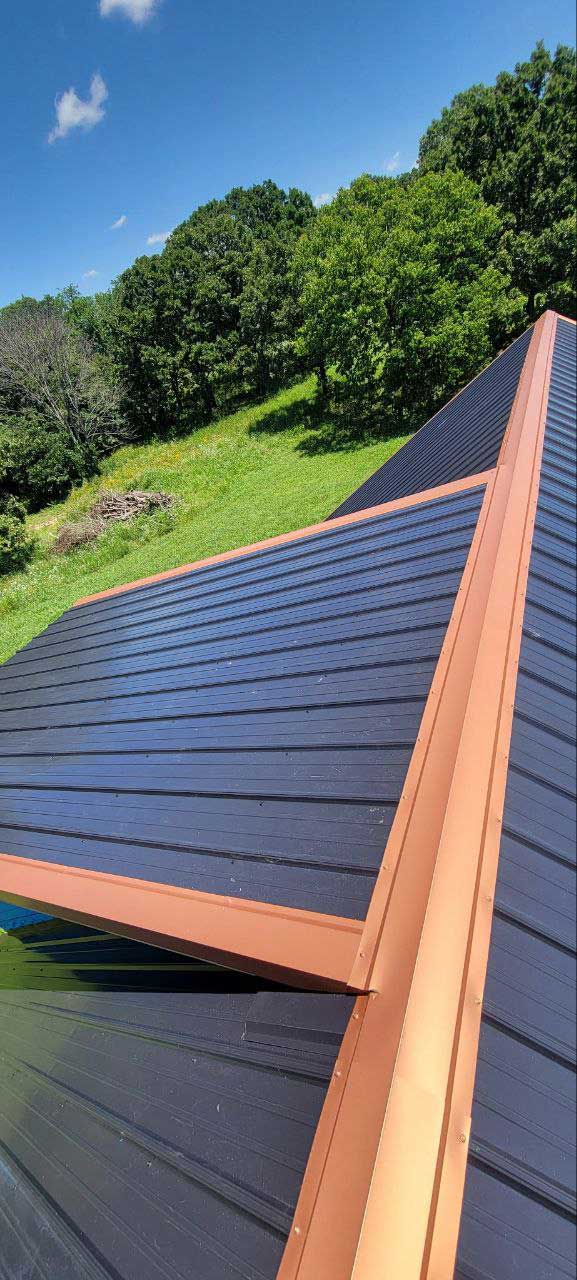
Profile is the shape stamped into the panel, and it does two jobs at once. Taller ribs spaced further apart carry a load better and shed water faster, which is what you want on the low-slope sections that turn up on additions and porch roofs. Shorter, tighter ribs read smoother from the ground and suit a house where you do not want the roof announcing itself.
The part people skip is the shadow line. A tall rib throws a hard stripe of shade down the slope in morning and evening sun, and on a steep older Saint Clair roofline that either flatters the building or fights it. There is no correct answer, only a right answer for your house, which is why we look at the place before picking. Panels come cut to your exact roof dimensions rather than trimmed down from stock lengths on the ground, so there are fewer raw edges, fewer seams for water to find, and a coating warranty on metal nothing altered after it left the mill.
Standing seam and exposed fastener are two different bets
Standing seam is the bigger check, and it demands more of the crew putting it on. In return there is nothing to age out and nothing to go back and tighten, since the system has no exposed gaskets or screw heads at all, which is why it earns its place on a house you plan to keep. The panels ride on concealed clips that let the steel move as it heats and cools, so nothing is fighting expansion.
Exposed fastener buys a great deal of coverage for the money, goes up quickly over simple gable framing, and is the honest choice for a barn, a shop, or a pole building. It depends entirely on its screws landing in framing at the right spacing, which is exactly why screw layout is not a place to hurry. Plenty of properties around here end up with both: the house in standing seam, the outbuildings in ag-panel, ordered in the same shade so the place reads as one property from the road. Both choices start from the same base metal, Galvalume rolled at an American mill and finished with a coating baked on at the plant, and the mill stands behind that finish under a warranty of its own, separate from the one we give you on the labor.
What hail and wind actually do to steel
Hail can dent a metal roof. A large stone leaves a dimple you may notice in low sun, more so on thinner gauge, and anybody who promises you a dent-proof roof is selling. What hail almost never does to steel is break through, so the roof keeps doing its job while a shingle roof gives up years of service life to the same storm. That is the trade, and it is a good one in a county that sits downwind of open ground.
Uplift is the test that separates the two systems furthest. A standing seam panel is held by clips along its whole length, so uplift has to fight the entire seam rather than one tab at the edge. Exposed fastener holds fine when the screws are in framing on the correct pattern and starts backing out when they are not. If steel is going on a building that faces the open west side of the county, that layout is the detail worth asking about, more than the color or the price per square.
The question worth asking before you buy either one
Steel is a bigger check on the day you write it. The useful question is not what it costs today but how many roofs you plan to buy for this address over the rest of your life. Somebody five years into a house they intend to hand down is answering differently than somebody planning to list in three, and both answers are legitimate.
That is the conversation we would rather have on the roof than over the phone. Sometimes the honest recommendation is another round of architectural shingles, and we will say so even though steel is the bigger job. If you want the full breakdown of panel families, underlayment and ventilation, it is on the Saint Clair metal roofing page. If the roof you have now is the real question, a free roof inspection gets you a written assessment before you decide anything, and if a storm is what started this, storm damage repair is the place to start instead.
Common Questions
What gauge should I be asking for?
What gauge should I be asking for?
Twenty-nine is fine over a shed where the roof is only doing a job. Go to twenty-six on anything a hailstone can find, which covers most of St. Clair County. Twenty-four is standing seam thickness that holds a flat plane over long runs without waving. If a quote does not name the gauge, ask before you compare it to anything.
Is a steel roof loud when it rains?
Is a steel roof loud when it rains?
Over solid decking and underlayment, no. What people remember as loud is steel screwed straight to purlins on an open barn with nothing underneath it. A house roof has a deck, underlayment and an insulated attic in between, and it sounds about like shingles do.
Can you put steel over the shingles that are already up there?
Can you put steel over the shingles that are already up there?
Sometimes. It depends on the condition of the decking, how many layers are already on, and whether the old surface is flat enough not to telegraph through the panels. Soft decking always means tear-off. That call gets made after somebody looks, not over the phone.
Two numbers and a rib shape decide most of what you will think about a steel roof ten years from now. Anybody quoting you a metal roof should be able to tell you the gauge, the profile and where the fasteners are landing without reaching for a brochure. We walk the buildings, photograph what is up there, and put the recommendation in writing so you can sit with it. You will be talking to Preston or Heber, not a salesman working a territory.
Weighing Steel for a Saint Clair Roof?
Free look at the house and the outbuildings, with the panel recommendation and a price in writing. No pressure to sign anything on the spot.
Free Hail Inspection (417) 808-0802