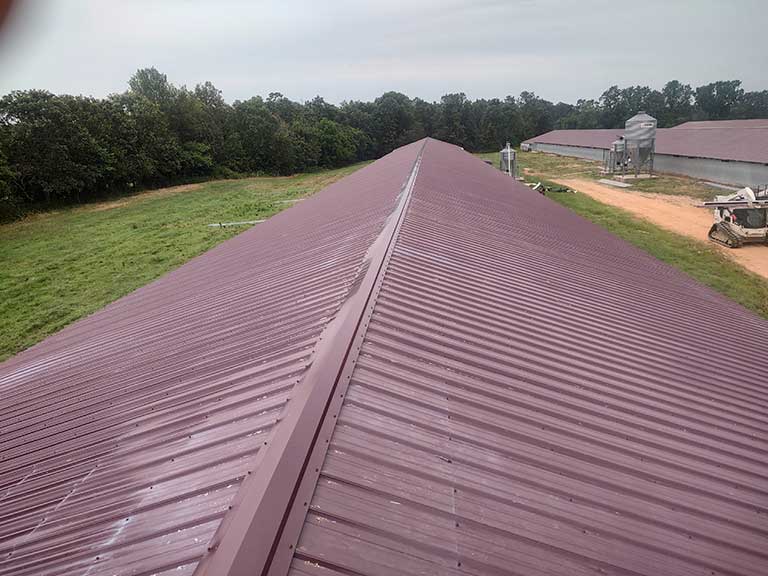
An exposed-fastener steel roof, the ag panel on barns, shops and plenty of rural houses around Bolivar, almost never leaks because the steel wore out. It leaks at the screws. Every fastener goes through the face of the panel with a rubber washer under its head, and after enough summers those washers harden, crack and quit sealing. Screws back out as the panels move with heat and cold, and the laps and ridge cap open up. Most of the time a careful re-screw and a ridge reseal put the roof right. When the panels themselves are failing, or a house is coming off shingles, other options come into play.
Out past the edge of Bolivar, a lot of barns, machine sheds and rural homes wear exposed-fastener steel, and it is a sensible roof: light, quick to put on, and long-lived when somebody looks after it. The trouble is that most of these roofs are never looked at until a brown ring shows up on a ceiling or the hay under the ridge gets wet. Then the question becomes whether the whole roof is shot. Usually it is not. Here is where panel roofs actually let water in, and how we decide between fixing one and replacing it.
The washer under each screw head wears out first
Ag panel is held down by screws driven straight through the face of the steel. What keeps water out of each hole is a small rubber washer pressed tight under the screw head. That washer sits in full sun on a hot roof, freezes every winter, and gets squeezed and released as the panel moves. The steel can outlast it by a long way.
A failing washer rarely looks dramatic. From the ground the screws all look alike. Up close the rubber is hard and chalky, cracked around the rim, or squashed thin and pushed out to one side. Water rides down the panel, finds the gap and follows the screw shank into the purlin and whatever sits below it. On a barn that might be a tractor seat. On a house it shows up as a stain on the ceiling, usually a few feet from the screw that caused it, because water travels along the framing before it drips. That travel is why a homeowner can chase a panel leak for a year and never find it.
Why screws back themselves out
Steel grows when it heats and shrinks when it cools, and a long panel on a south-facing slope does plenty of both in one day. Each screw is pinned at a single spot while the panel creeps a little underneath it. After years of that the hole elongates, the fastener loosens, and some screws work partway out until the head stands proud of the washer.
Bad installs cause their own version of the problem from day one. A screw run in too tight crushes the washer flat and dimples the panel, leaving a small cup for water to sit in. A screw left too loose never sealed in the first place. When we walk a panel roof we look for all three: screws standing up, screws sunk into dimples, and screws that spin without tightening because the wood under them has stripped. Each needs a different fix, and a smear of sealant over the head is not one of them.
Laps and the ridge cap, where most panel leaks start
Panels overlap side to side and, on long runs, end to end. Those laps depend on the stitch screws and the sealant tape between the sheets staying tight, and wind can push water sideways or uphill into a lap that has opened even slightly. That is why so many panel leaks seem to come and go: dry in a gentle rain, wet in a blowing spring storm out of the southwest.
The ridge cap is the other usual suspect. It fastens through the high ribs of the panels with foam closures underneath to block wind-driven rain, and those closures shrink, slip or get chewed out by wasps and birds. Stand inside an older barn on a sunny day and you can often see daylight under the cap. We reseat or replace the closures, fasten the cap back into solid metal and seal the cap laps, so the highest line on the roof stops letting in what the rest of it keeps out.

Re-screw the roof, or re-panel it
If the steel is sound, a re-screw is usually the right call. We pull the old fasteners and drive new ones with fresh washers, stepping up a size where the original hole has stripped, and we reseal the laps and ridge while we are up there. It is slow, careful work done one screw at a time, and it gives a healthy panel roof a long second life for a fraction of the disruption of tearing it off.
Re-panel becomes the answer when the steel itself is going: rust that has eaten through instead of sitting on the surface, sheets bent or punctured by hail or falling limbs, or a roof with so many wallowed-out holes that new screws have nothing left to grab. Patching sheets one at a time on a roof like that leaves a quilt of mismatched steel and a leak list that never gets shorter. We photograph what we find and tell you which side of that line your roof sits on. The full set of options is on our metal roofing in Bolivar page.
Moving the house off shingles? Look at standing seam first
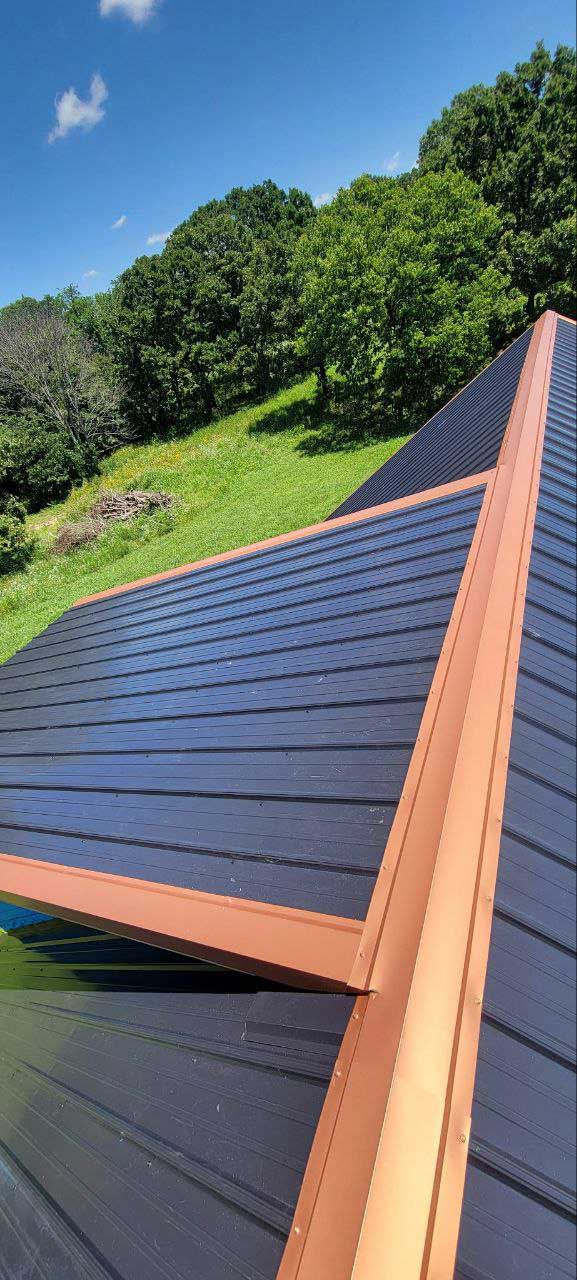
People replacing a worn shingle roof often ask about putting ag panel on the house, since it has done fine on the barn. It can be done. On a home, though, we usually point people toward standing seam. Its fasteners sit under the panel, hidden inside the seam where sun and weather cannot reach them, so there are no exposed washers to age out. The panels are also free to move with temperature without working against the screws that hold them.
Exposed-fastener steel is still a fine choice where it fits. On a shop, a machine shed or a barn it is hard to beat, and a properly fastened ag-panel roof on an outbuilding will give you very little trouble. The decision comes down to the building and how much upkeep you want to sign up for. If you are weighing metal against new shingles, our residential roof replacement page covers that side, and if hail or wind recently worked your panels over, start with storm damage repair.
What people ask about ag-panel roofs
Can I just put sealant over the screw heads?
Can I just put sealant over the screw heads?
It slows a leak for a while and makes the real fix harder later. Sealant over a dried-out washer does not restore the seal under the head, and it hides the screw so the next person cannot tell whether it is loose. A new fastener with a fresh washer does the job properly and lasts far longer than a dab of caulk.
How do I find where a metal roof is leaking?
How do I find where a metal roof is leaking?
Start inside. Note where the water shows up, then remember it usually ran along a purlin or rafter before dripping, so the source tends to be uphill and off to one side. On the roof, check every screw near that line, the nearest lap and any pipe or vent. In a barn, look up on a sunny day for light at the ridge.
Do you work on barns and shops or only houses?
Do you work on barns and shops or only houses?
Both. A good share of the metal work we do around Bolivar is on outbuildings, and we can look at the house and every building on the place in one visit. If the shop needs a re-screw and the house roof is fine, that is exactly what the written quote will say, and nothing more gets added to it.
Most leaking panel roofs are under-maintained rather than worn out, and the fix is new fasteners, tight laps and a ridge that seals. Have the roof walked before you decide it needs replacing. Preston or Heber will climb it, photograph what we find and tell you plainly whether it needs screws or steel.
Water Getting In Around the Screws?
We walk the panels, laps and ridge on your house, barn or shop around Bolivar and tell you whether new screws, new panels or a new system is the honest answer.
Get a Written Quote (417) 808-0802Bolivar roofing and metal work · More from the blog · Talk to Heber