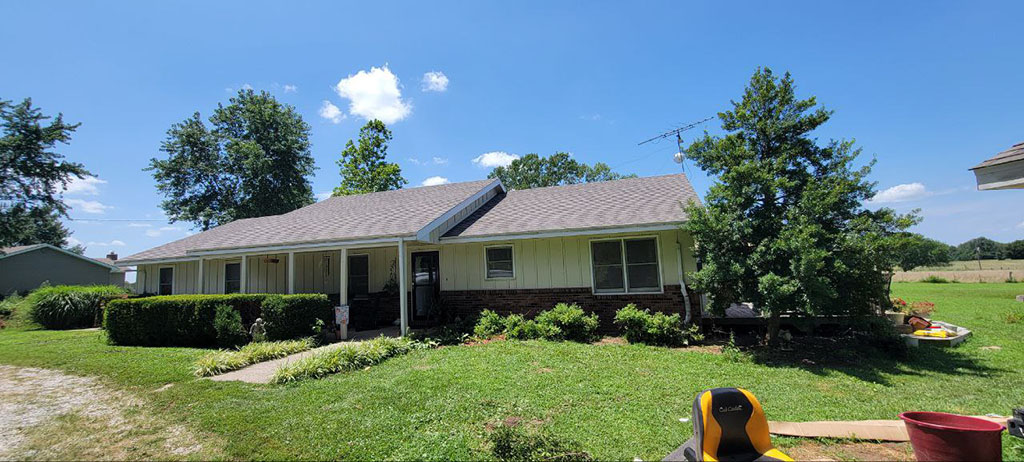
There is no magic number of patches. A roof moves from repairable to done when several signs show up together: repairs scattered across more than one slope, shingles from different eras side by side, bare spots where the granules have washed into the gutter, decking that flexes underfoot, and a leak that returns every spring no matter who fixes it. When two or three of those are present, another repair usually just moves the next leak somewhere else. On most single-family Bolivar homes a replacement is torn off and dried in the same day.
A lot of the older homes around Bolivar have roofs that were never fully replaced. They were patched. A storm took a few shingles and somebody nailed in new ones. A pipe boot leaked and it got a bead of caulk. Each fix made sense on its own. Enough years of that and the roof becomes a collection of repairs, and the homeowner asks us the honest question: fix it again, or is it time? This is how we answer it when we are standing on the roof, and what we show you so you can judge it yourself.
A patched roof keeps its own record
From the yard an older roof can look uniform. Up on it, the history is easy to read. Newer shingles stand out because they lie flatter and darker, or carry a slightly different color blend from a different production run. Black roofing tar smeared around a vent or down a valley marks a leak somebody chased. A line of exposed nail heads near the peak says a ridge cap got reset at some point, probably in a hurry.
One or two repairs in one area are normal and mean very little. A roof with patches spread over several slopes is telling you the shingles are failing in general, and each repair only fixed whichever spot happened to leak first. That spread matters far more than the count. We photograph every repair we find so you can see the pattern for yourself, and so the decision rests on what is actually up there instead of on our say-so.
Mismatched shingles and missing granules
Matching an old roof is close to impossible. Shingle colors and profiles change over the years, and the shingles already on the roof have faded besides. That stays a looks problem until the patches start to outnumber the original field, and then a house can end up with a checkerboard on its front slope and a resale headache on top of a leak.
Granule loss is the sign that matters more. The granules on an asphalt shingle shield the asphalt underneath from sun. As they wear off they collect in the gutters and at the foot of the downspouts as a coarse dark grit, and the shingle turns smooth, shiny or black in patches. Shingles in that condition are past reliable repair. New nails crack them, and a fresh shingle slid in beside them sits on a roof that keeps aging out around it.
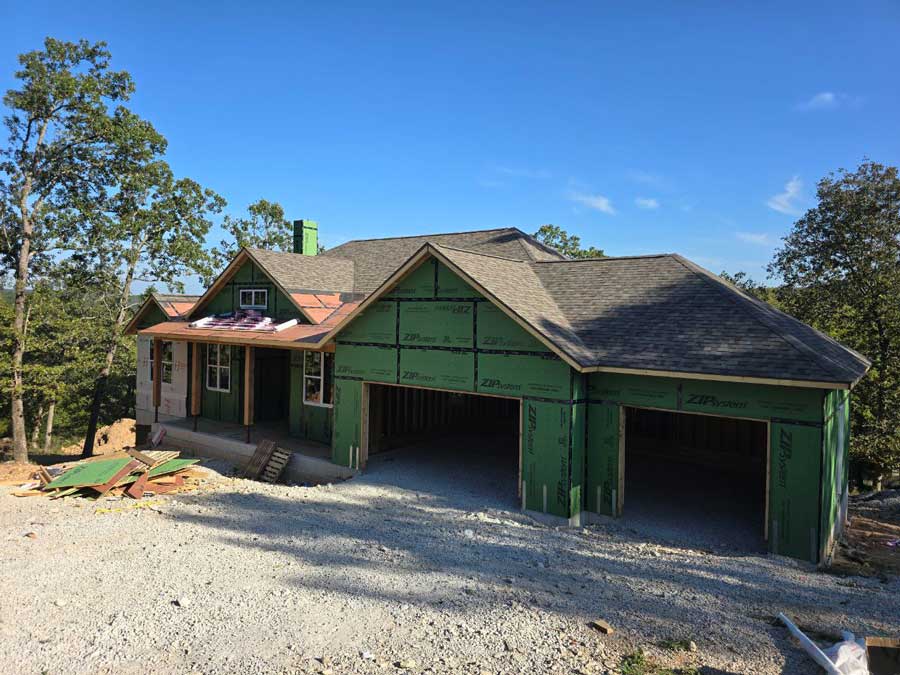
What soft decking feels like underfoot
Walking a roof tells us things no photo can. Sound decking feels firm and even. Decking that has taken on water over the years feels spongy, flexes between rafters, or dips in a soft spot near a valley, a chimney or the bottom edge where water collects. Sometimes the dip shows from the street as a faint sag in an otherwise straight slope.
Soft decking settles the question for most roofs. Shingles cannot be nailed securely into wood that has started to break down, so even a careful patch in that area will not stay put. It also means the leak has been going on longer than the stain inside suggests. On a replacement we strip the old roof to the deck, replace any bad sheets we find, and only then start the new roof. Before the job we tell you what we expect to find, and afterward we show you what we actually found.

The leak that comes back every spring
One of the clearest signs we hear about is a leak that disappears over the summer and returns with the storms. Bolivar gets its heavy weather in spring, with hail and hard rain coming up from the southwest, and a roof with tired shingles and loose flashing will find a way to let some of it in. It gets patched in May, stays dry until the next year, and the cycle repeats.
A leak that keeps returning usually means the repair treated the spot where water came through the ceiling instead of where it entered the roof, or that the roof around the old patch has since failed too. A couple of springs of that and the aggravation adds up: buckets, stained drywall, another call, another patch. A replacement removes every one of those weak points at once, including the flashing and underlayment nobody can see from the yard.
One day on the roof, booked for the right season
Most of our customers in Bolivar have jobs and schedules, and nobody wants to stand in the yard watching a crew all week. Most single-family re-roofs here are torn off and dried in the same day. We give you a real start date and show up on it. As an Owens Corning preferred contractor we install the full system the way the manufacturer specifies, which is what keeps the workmanship and material warranties intact on a roof you plan to keep.
If your roof is tired but not actively leaking, timing helps. Spring is when every roofer in the area is buried in hail work, so a planned replacement booked for late summer or fall tends to start sooner, and fall weather lets new shingles seal down before the freeze and thaw of winter. Our residential roof replacement in Bolivar page walks through the job step by step. If a recent storm is what pushed the roof over the edge, start with storm damage repair instead.
Before you decide
Is there a number of patches that means I need a new roof?
Is there a number of patches that means I need a new roof?
No fixed number. We look at where the patches are more than how many. Several repairs clustered around one chimney can be a flashing problem. Repairs spread across different slopes, combined with granule loss or soft decking, usually mean the shingles are failing everywhere and another patch only moves the next leak. We will tell you which one you have.
Can you match my old shingles for one more repair?
Can you match my old shingles for one more repair?
We can get close on color and profile, but rarely exact, because the old shingles have faded and product lines change. On a back slope that may not bother you. On the front of the house, a visible patch can be reason enough to look at the whole roof, especially when other signs of age are already showing.
Do I need to be home during the tear-off?
Do I need to be home during the tear-off?
No. Most single-family re-roofs in Bolivar are torn off and dried in the same day, and we work around households that cannot stay home. We need a clear driveway and access to the yard. If we find bad decking, we call you and send photos so you see it before we replace it.
If your roof has been patched more times than you can remember, have someone walk it and give you a straight answer. If it can be repaired, we will say so and quote the repair. If it needs to come off, we will show you the photos that explain why, and put the whole job in writing.
Tired of Patching the Same Roof?
We walk your Bolivar roof, photograph every old repair and soft spot, and tell you in writing whether it needs a fix or a full replacement.
Get a Written Quote (417) 808-0802Roofing across Bolivar · More from the blog · Ask about your roof